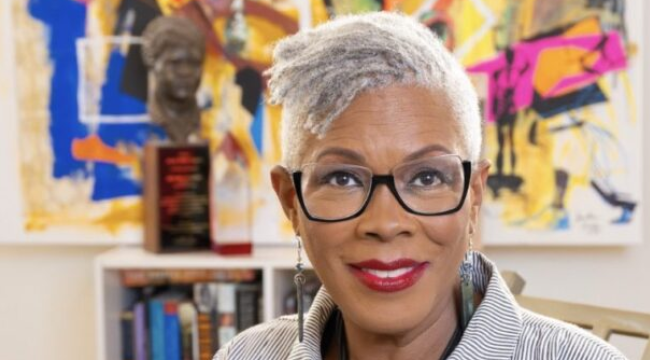
After 25 Years of Telling Detroit’s Story to the World, Rochelle Riley is Heading to South Carolina
For a quarter-century, Rochelle Riley has built an address book of contacts across Michigan that, if compiled in print, would probably rival that of the old Yellow Pages that used to drop on our doorsteps annually. Through these connections, Riley has been able to find the right person for the right job at every level, be it for correcting a bank error at her preferred financial institution or assembling a mass tribute to victims of the COVID-19 epidemic on Belle Isle.
In the days leading up to March 13, however, Riley found a glaring absence in her Rolodex: She couldn’t find a good moving company.
“Do you know a good moving company?” Riley asks this editor before going into an hourlong conversation about why, after a quarter-century and change, she’s headed back to her roots in the Carolinas after a lengthy stint in Detroit where she’s held three notable roles: Two official ones, as a metro columnist at the Detroit Free Press and later Director of Arts, Culture and Entrepreneurship at the City of Detroit, and a third unofficial position as holder of the city’s bully pulpit.
In between packing boxes and answering voicemails, Riley is gearing up for her next chapter in Charleston, S.C., as that city government’s Director of Cultural Affairs. The Tarboro, N.C., native goes out on a high note with a celebration of her time in Detroit at the Charles H. Wright Museum of African American History on March 13 – 313 Day – with a bevy of guest speakers and well-wishers.
The future of Detroit’s municipal arts and culture arm, which is a division of the City’s General Services Department, is unknown. Riley, who was hired into the role of director in 2019 under former Mayor Mike Duggan, tells the Chronicle she doesn’t know if Mayor Mary Sheffield has plans to appoint a successor. In her inaugural budget proposal to City Council on March 9, Sheffield included a proposed allocation of city budget funding for GSD to continue operating the arts and culture office. An inquiry to Sheffield’s press team for more clarification about the budget, as well as a potential replacement for Riley, was not met by press time.
Whether the City appoints another arts director or not won’t fill a bigger void that opens upon Riley’s return to the Carolinas. Since leaving her post at the Detroit Free Press in 2019, there has not been a regular Black woman columnist at either of the metro dailies – or a regular Black columnist at all. And many of the causes Riley championed during her 19 years at the Freep and issues she brought attention to – particularly calling attention to the city’s dismal literacy rates – haven’t quite permeated the city’s consciousness the same way since.
“The thing that that was exciting for me was, I came to a city where there were already Black women who had either been writing or were writing, and it wasn’t just me. And now, it’s voiceless,” Riley says. “For a second, I thought, ‘am I allowed to stop? Do I have to go back to my column because nobody’s doing that?’ And then I decided — that’s not fair to me if I found something else that I really love doing. I gave a lot of time to journalism and to communities into being that public servant.”
Riley arrived in Detroit in 2000; her first day at the Freep was Sept. 11 of that year. Prior to that, she was a deputy managing editor at the Louisville (Ky.) Courier-Journal. At the time, the Detroit media market was flush with Black women editors and columnists, among them the late Betty DeRamus, a former Chronicle staff writer who went on to work for The Detroit News before her passing earlier this year, and Free Press columnists Susan Watson and Desiree Cooper.
“Bob [Robert] McGruder,” Riley says, speaking of the former Free Press Executive Editor, and noteworthy champion of industry diversity across the journalism landscape at large, “was my favorite editor in the country. Not many newspapers had a Black top editor, and he asked me to come – and I did. And I stayed for him.”
She tells a story indicative of the influence newspaper columnists had back in the day. Shortly after moving to Detroit, Riley said she walked into the nearest branch of her bank in pajamas asking why all her money had been drained from a then-new account. After demanding to talk with a supervisor, the staff directed her to the manager’s secretary.
“And I asked, ‘is this a Little-S secretary or a Big-S secretary?” she says. After being directed upstairs, the secretary looked at Riley and looked at the copy of the Free Press on her desk, which featured Riley’s photograph and news that she’d be debuting a three-day-a-week column in the paper. The issue was rectified immediately.
Columnists at newspapers – this publication included – aren’t celebrities entitled to special treatment, which is not the reason why Riley’s money was restored sooner than the average customer. Instead, because they are essentially faces of their respective publications, they are entrusted with elevating issues to the forefront of the public’s mind while still being at level with their audience. A bank in that institution’s position was likely more concerned with its own reputation.
For Detroit, a city that was majority Black when Riley arrived here and continues to be as she packs, Black columnists carried a different weight. Riley is careful to note that every column she’s written wasn’t exclusively for or about Black people. Many of her topics du jour, however, did tend to resonate deeper with us.
Take for instance the decision to tear down Joe Louis Arena in 2019. Riley wrote that after the venue, built in 1970, was the most prominent structure in the city limits to bear the Brown Bomber’s name. (Trivialists will argue that the Monument to Joe Louis statue that sits at the end of Woodward Avenue in front of Hart Plaza — otherwise known as “The Fist” — is another one, but Riley’s argument was that the arena was indisputably known by who it was named for.) That led to more awareness to keep Louis’ name alive in town and why we have the Joe Louis Greenway.
“I wrote a column saying that the Motown Museum needed to be expanded into this national treasure because – I’ll never forget, I really upset Mrs. Cole [of James H. Cole Home For Funerals] — because this was when they were talking about moving the Motown Museum to Woodward Avenue to some building,” Riley says. And I said, the Motown Museum needs to expand right where it is, and maybe Cole Funeral Home can be relocated, and they take over that whole corner,” Riley says.
“Mrs. Cole didn’t speak to me for a year,” she laughs – but the Cole funeral home did not move. In fact, as residents see now, Motown decided to remain in place at West Grand Boulevard and expand from there.
“I wrote a column back when the riverfront looked like crap and said, ‘God, I wish we could do what Louisville did,’ because Louisville had the same thing, silos and cement buildings, and they turned it into this showplace. Now look at the Detroit Riverfront.
“I’m not saying these things happen because of me,” Riley clarifies. “I’m saying people were talking about these things, and they needed people to be excited about them.”
Riley came into the news business at a challenging time for Black journalists, particularly women. Her first newspaper gig after college was in her home state of North Carolina at the Greensboro Daily Record, two-and-a-half hours from where she grew up in Tarboro. Like Detroit, Greensboro was a “two-newspaper town,” a term the media industry uses to describe cities that publish two daily newspapers. (The terminology is admittedly exclusionary, and perhaps a bit discriminatory, to weekly papers like this one.) Unlike Detroit, however, was the kind of blatant, Southern-brand racism Riley encountered well into her adult years.
There were times on the job when she’d be called the N-word with a hard-R. “I would never have thought there was a Klansman anywhere north of the Mason-Dixon Line. I don’t know that there wasn’t, but it just wasn’t a thing. But there, you know, you were used to people in white sheets. I grew up at a time where there were still people in white sheets,” Riley says.
She then took a job covering news at The Washington Post – still a Southern city by geography, but a chocolate one. “Washington was a Chocolate City and owned it,” she says.
The Post at the time was a go-to for journalists following in the footsteps of Bob Woodward and Carl Bernstein, the two reporters who broke the Watergate scandal wide open. Decades later, even after ownership changes – it was once held by the Graham family, which currently owns local NBC affiliate WDIV, but is now operated by Amazon founder and CEO Jeff Bezos – and staggering layoffs earlier this year, the publication still holds a certain allure with working journalists.
For Black women at the Post, however, they’ve had to operate on a different scale. Not long before Riley’s tenure there was a newsroom scandal taught as a cautionary tale to generations of journalism school graduates, but largely unknown among the general public: The 1981 retraction of several articles by Janet Cooke, a Black woman reporter who fabricated a narrative about a nonexistent juvenile heroin addict that won her and the Post a Pulitzer Prize that was immediately rescinded after the falsehoods were uncovered.
Riley recalls herself and other Black women in the field encountering a different kind of racism. “It was covert, not overt,” she says, describing the additional scrutiny she and her colleagues received at the time in mostly white newsgathering environments.
After a stint at the Dallas Morning News and then landing in Louisville, Riley became more “fearless” during her nearly 20 years at the Free Press.
“I never once thought about what somebody would say about what I wrote,” she says. “It wasn’t like, ‘oh my God, if I write this, then somebody’s going to call and curse me out.’ Like when I first started writing about adult illiteracy and how bad it was in Detroit, and people were calling me saying, ‘why are you telling people that?’ And of course, that meant I did it for another 15 years.”
“I just did what I thought was right,” Riley adds. “And for people who wanted somebody to do what was right, or somebody to encourage people to do what was right, they were glad somebody was saying it.”
Riley points to several more topics she’s covered that readers are familiar with now. She was an early bullhorn for calling attention to thousands of untested rape kits in Wayne County and amplified the idea of dividing the city into council districts.
“When I got ready to leave the Free Press and they had a party in the newsroom, [then-Executive Editor Peter Bhatia] says, ‘okay, so here’s Rochelle, and we all know she’ll throw a grenade in a room, and we’re going to miss that voice and that person who, if they see something, they’re going to call it out.’ And I didn’t think about it at the time because it wasn’t planned,” she says.
But another recurring theme was appearing in her writing: Getting Detroit to realize the potential of its own untapped cultural resources.
“Art is business. Our creative workforce is made up of some of the most talented people anywhere in America, and they need to be treated like a workforce. Other cities get it. New York gets it. Seattle gets it. Austin gets it. Atlanta gets it,” she says.
“But we ought to embrace every kind of art. And we ought to own everything that we own,” Riley adds. Detroit DNA is in everything. Everything – fine arts, music, every music [genre]: techno, jazz, rock and roll; Detroit built the sound of young America for white folks and Black folks. You can stand on the street corner of Detroit now and start singing the Temptations and five white guys will walk up and sing it with you. It doesn’t matter what color it is. What matters is that you all know the song.”
Just as Riley launched the Office of Arts, Culture and Entrepreneurship at the City in 2019, the COVID-19 pandemic struck a few months later the following year. Riley envisioned a public memorial for the growing tally of those lost to the virus, which manifested into large portraits of Detroiters displayed all around Belle Isle. The memorial remains one of Riley’s proudest, if somber, accomplishments.
Among Riley’s other highlights working at the city was the installation of nine murals in across in the city, appointing both a city historian and poet laureate, and generally strengthening the link between city government and the creative industries, both locally and nationwide.
“When I got here, there wasn’t a national chain grocery store, and Woodward Avenue had all these vacant buildings. I almost quit because I found out there wasn’t a movie theater here and we had to go to the Star Southfield every week,” Riley says. “And as the city kept changing and kept getting better, it’s almost like I didn’t want to leave because it was unfinished business — and anything I could keep doing to get people to believe how great Detroit was.”
A certain voice is still missing from the media landscape, and a void will be evident upon Riley’s departure. Even while she was employed at the city, Riley says, the Free Press’ editorial page editor would still ask her to contribute to the paper.
“I gave decades to journalism into doing what it is. And now, journalism is not what it used to be. I’m very saddened by the state of journalism,” Riley says. “I don’t see stories about things that there ought to be stories about. I don’t see people questioning things that there ought to be, not just questions, but demands and outrage about things. And, you know, I did it. I did it for a long time. I did it proudly.
“Is there this void? Is there this hole? Yes,” Riley adds. “Am I the one to fill it? Not anymore, but I’m going to always love Detroit and every now and again I’m going to still throw a grenade in a room.”
SIDEBAR:
Rochelle Riley spent nearly 20 years chronicling the lives and sharing the feelings of Detroiters about, well practically everything. She cares about our children, our seniors, the way we live and how Detroiters should live as well as anyone in any city in America or the world. In more than 1,000 columns, she was our voice. She took elected officials to task when necessary, and she wrote beautifully about people who may have never had a moment in the sun without her. Friends of Rochelle (F.O.R), a group of friends, mentees and others, are compiling tributes and stories from people whose lives were changed by Rochelle. She has received text messages with copies of columns she wrote about you as children or about your service as a teacher. After a quarter century of stellar public service to Detroit, as a columnist and then as an arts advocate in 2025, Rochelle deserves her flowers while she can be moved by them. So, if you appeared in a column or were among the many artists she worked with or provided funding for or supported with her presence, please send those memories, instances of inspiration or ways she helped you to FriendsOfRochelle25@gmail.com, attention Leah. The deadline is May 1.
You can reach Aaron at afoley@michronicle.com.