
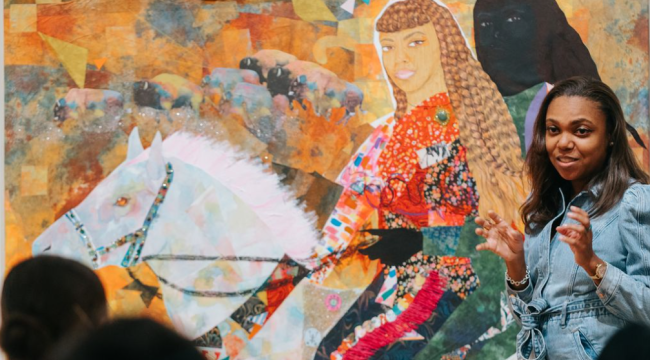
Detroit Artist Jamea Richmond-Edwards Brings Her Largest Exhibition to Wellin Museum of Art
Detroit artist Jamea Richmond-Edwards is the subject of the largest exhibition of her career at the Wellin Museum of Art at Hamilton College, where Another World and Yet the Same remains on view through June 14, 2026.
The exhibition features a new body of large-scale work alongside collage-based paintings from the last seven years. Together, the pieces explore race, class, identity, family, style, memory, and the political and emotional weight of imagining a different world while standing inside this one.
For Richmond-Edwards, that vision began taking shape after a return home.
“I have recently moved back to Detroit after being away for 22 years,” she told the Michigan Chronicle. “I moved back with my family in 2021.”
That move back to the city forced a fresh look at Detroit, not from the distance of memory, but from daily life. The weather hit first.
“One of my biggest adjustments was acclimating to the weather,” Richmond-Edwards said. “Like it was so cold to me.”
She had moved into a house in Boston-Edison, and the winter made itself known fast.
“What they don’t tell you is on my first floor I have like 42 windows or something crazy,” she said. “When you ain’t winterized, my home was literally freezing.”
That experience helped open the door to the exhibition’s visual world. Richmond-Edwards said a visit to fellow Detroit artist Mario Moore’s studio sharpened the idea.
“I went by his studio and he did these paintings of the women in his family in fur coats,” she said. “Growing up, I’ve been in art my whole life visiting museums and you rarely see Black people in a context of winter and enjoying it. So that was the spark of it.”
That spark turned into a larger meditation on Detroit, Black life, style, escape, and survival. Richmond-Edwards said she began building the work three years ago, at a time when the direction of the country and the broader world felt unstable.
“At the time when I started creating this work three years ago, I kind of began foreseeing the direction of the world,” she said. “And I’m just like, we are headed into a very interesting space. My art for me is a form of escapism.”
That line of thinking led her to imagine a journey as far away as possible.
“So I was like, okay, I’ll just do a voyage to Antarctica,” she said.
The exhibition title comes from a 17th century dystopian text, Mundus alter et idem, or Another World and Yet the Same, which imagined a voyage to a different world as a critique of the existing one. Richmond-Edwards adapted that premise into a new narrative centered on a character of her own creation: Iceberg, a young figure who leads family and friends toward Antarctica in search of another way forward.
“I came across this 17th century dystopian tale that was titled ‘Another World, and yet the same’ about these sailors who were dissatisfied with the government,” she said. “So they went on a mission and was like, we sailing to a whole other world.”
She did not leave that story in the abstract. She brought it home.
“I decided to use all my family as subjects in my painting,” Richmond-Edwards said. “And the main protagonist is Iceberg, who has the likeness of my middle son.”

Jamea Richmond-Edwards, Terra Sancta, Terra Sancta, from the series Another World and Yet the Same, 2025. Acrylic, glitter, graphite, ink, marker, oil pastel, and mixed media collage on canvas. 96 × 144 × 5 in. (243.8 × 365.7 × 12.7 cm). Courtesy of the artist. Photograph by John Bentham.
She said the name came with intention.
“I was like, I’m going to call him Ice Cold, because in order to lead your family on this trip, on this journey, you got to be ice. You got to be cold.”
The family voyage operating at the center of the exhibition works on multiple levels. It is a fictional passage. It is a political reading of the country. It is also a personal one.
“One end, it’s America,” she said. “But then on the other end, it’s really an allegory of paths and rites of passage that we have to cross in our lives.”
She pushed that meaning further when talking about what Antarctica represents in the work.
“Antarctica is just a representation of my ego and my cold heart,” she said. “So really using the work as a tool of self-liberation.”
That emotional and political depth is grounded in a practice long shaped by Detroit. The exhibition materials describe the city and its music as a strong undercurrent in Richmond-Edwards’ work, pointing to jazz, soul, Motown, techno, and hip hop as important influences. Her paintings often feature herself, family, and friends in vibrant dress against decorative backgrounds, with nontraditional materials and references to marching band movement and regalia woven into the compositions.
Richmond-Edwards said Detroit has always been central to how she thinks about art.
“So I am a Detroit public school graduate,” she said. “From K through 12, was raised between West 7 Mile and the east side where my grandmother stayed. So I would split my time between both sides, but I rep 7 Mile, you know how we do in Detroit.”
She grew up inside a culture where music, movement, and style were part of everyday life, not separate from art but inseparable from it.
“My mother is like a daughter of Motown,” she said. “My mom’s a dancer. So I seen her on the weekend wearing her fur coats, her and her husband, they go out dancing driving their Cadillac. So very much embedded in Detroit culture. It’s nothing like Detroit culture.”
Her own artistic path started early.
Richmond-Edwards said she had access to gifted and talented programming as a child and attended classes at College for Creative Studies (CCS) from a young age. She later earned her bachelor’s degree from Jackson State University and an MFA from Howard University. The exhibition materials also note that her work has been shown at major institutions including the Brooklyn Museum, the California African American Museum, the Charles H. Wright Museum of African American History, the Museum of Fine Arts Houston, and the Phillips Collection.
But this show marks a different level of scale.
“To have a largest exhibition to date,” she said, “eight paintings that are of monumental scale, including the film, that’s a really large feat.”
She said the work took three years to develop and demanded more than creativity. It demanded physical and emotional endurance.
“I’m 5’3, and I created this body of work by myself,” she said. “The largest piece in the show is 8 feet by 18 feet.”
Richmond-Edwards said the labor of making the exhibition unfolded alongside the realities of grief, financial pressure, and the broader instability of the moment.
“The economy is jacked up. Family has passed. Going through financial adversity,” she said. “Just getting over the adulting and humanity of feeling like the world is crashing, and I’m in here painting.”
Still, she kept going.
“No, this is really important for me to do,” she said.
That commitment has resonated well beyond Detroit. Richmond-Edwards said visitors at Hamilton College in New York, where the museum is based, have connected with the work in ways that affirmed both its specificity and its reach.
“It’s just really such an honor to hear people’s interpretation, especially coming from a completely different geography,” she said. “And they get it and they immediately get it.”
That response matters because Another World and Yet the Same is deeply rooted in Detroit while speaking to a much wider set of anxieties and possibilities. It is about cold, family, migration, imagination, and the search for a place that can hold Black life with more dignity than the present often does.
Richmond-Edwards said that work belongs to artists too.
“I believe that humanity’s future rests not only in the hands of politicians or scientists, but also in the ability of artists to imagine alternate futures,” she said.
At the Wellin Museum, that imagination is on full display. So is the Detroit that shaped it.
Sorry, the comment form is closed at this time.