Banker who saw his neighborhood lose a bank is now investing $20M in Detroit
When Kala Gibson was 12 years old, he was already learning what it meant to be a banker.
He had a paper route. He was making his own money and putting it in the bank, learning early about saving, entrepreneurship and financial literacy.
Then one day, he went to his neighborhood branch and found the doors closed.
His mother told him there was another branch around the corner. But Gibson noticed something else.
“When that branch left the neighborhood, everything else left,” he recalled. “So it went from being a financial desert, and eventually became a food desert and other things started to leave as well.”
He never forgot it.
The experience helped shape the career he would choose. At 18, while attending Grand Valley State University, Comerica hired him. He spent 20 years there and ultimately built a 36-year career in banking.
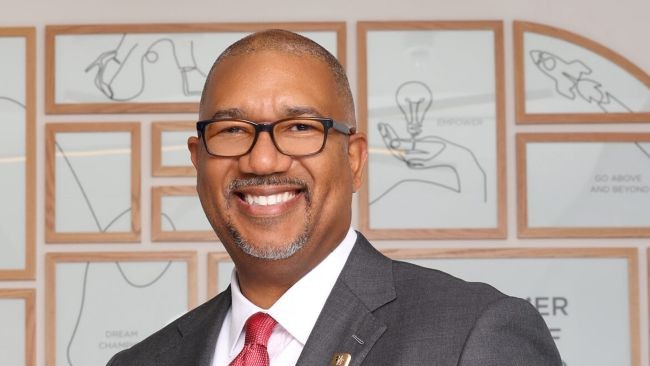
Now, as chief corporate responsibility officer for Fifth Third Bank, Gibson is in a position to do something his 12-year-old self could only have imagined: help put capital back into Detroit neighborhoods and measure whether that investment actually changes people’s lives.
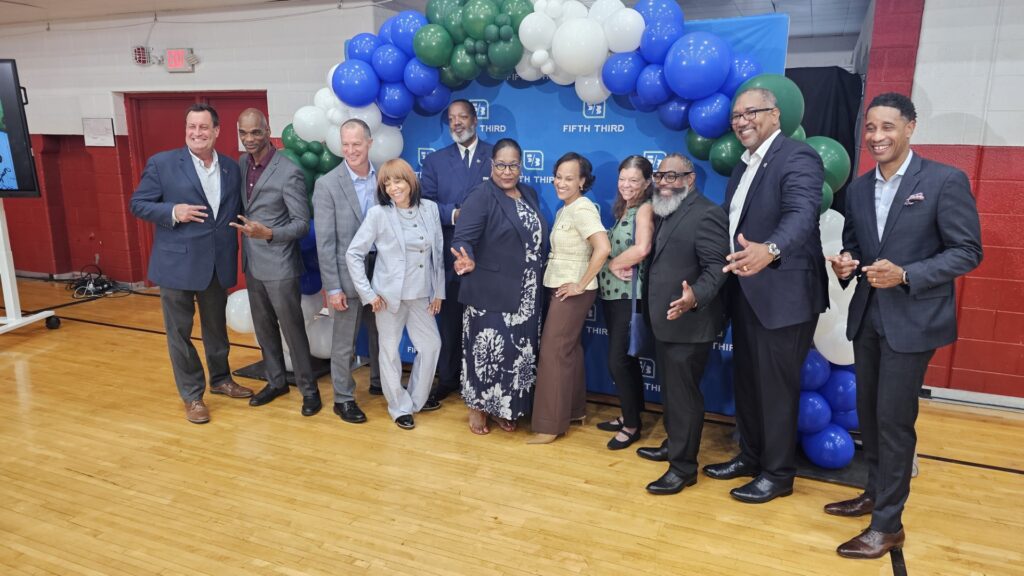
That is the idea behind Fifth Third’s new $20 million commitment to Detroit’s Gratiot/Seven Mile and Denby/Whittier neighborhoods.
But for Gibson, the $20 million isn’t really the story.
“The story is going to be what the outcomes are,” he said.
Fifth Third is bringing its Neighborhood Program to the two communities as part of its new Building Stronger Communities framework, a five-year, place-based approach that combines lending, investments, community-development financing, philanthropy and other resources.
The priorities include affordable housing and community development, small-business growth, homeownership, financial access and inclusion, sustainable communities and economic opportunity.
The bank is also providing nearly $400,000 in grants to local nonprofit organizations and completing a $1.25 million renovation of its Eastside financial center on Gratiot Avenue. Small businesses in the neighborhoods will also have access to capital through Fifth Third’s Small Business Catalyst Fund.
Gibson is reluctant to let the size of the commitment become the headline.
“One of my leaders, Susan Thomas, she’s like, we’re always fixated on this $20 million,” he said. “That’s not the story. The story is going to be what the outcomes are.”
That distinction is the real story to him because he has seen what happens when communities hear big numbers without seeing meaningful changes in their daily lives.
“A lot of times when you see those dollars that people are pushing into the communities, it’s all about the input, right?” Gibson said. “We did $10 million, we did $100 million, whatever the number is.”
Fifth Third intends to measure something different.
“We’re going to be measuring homeownership; we’re going to be measuring jobs that are created. We’re going to be measuring small businesses that are developed – not just the money that goes in,” Gibson said.
Ultimately, he said, the measure is whether people’s lives change.
That philosophy is particularly personal for Gibson because Detroit is not a market where Fifth Third is expanding its presence. It’s home.
Gibson is a native West-sider who was born at Henry Ford Hospital and spent his early childhood on West Grand Boulevard and Warren. His family later moved to the West Chicago and Evergreen neighborhood, where he remembers a thriving community after they arrived in 1977.
He remembers going to the Charles H. Wright Museum of African American History. He remembers his paper route. He remembers Junior Achievement on Grand River and Outer Drive, where bankers taughtchildren about financial literacy and entrepreneurship.
And he remembers what happened when his neighborhood’s bank disappeared.
“I don’t want to ever see that happen again,” he said.
That early experience also gave him a particular understanding of why financial institutions matter beyond the walls of a branch.
A bank can help someone open a first checking account, a small business owner access capital, a family finance a first home and build wealth.
And it can establish a relationship that lasts for decades.
Gibson knows that firsthand.
“The person that helped you with your first checking account, the person that puts you in your first house, maybe help you send your kids to college or vocational school, you’ll always be loyal to them and you’ll remember that,” he said.
That is part of what Fifth Third hopes to build in neighborhoods that have experienced disinvestment.
But Gibson said the first step is listening, not just selling a product.
“A lot of people in Detroit, and this is across the country, too, they feel forgotten,” he said. “Like no one cares, nobody’s even thinking about them.”
The new neighborhood program, he said, has to begin by changing that relationship.
“Someone is interested in learning about what my challenges are and what are the unique opportunities that may exist for me,” he said.
That means Fifth Third is relying heavily on organizations already embedded in the neighborhoods rather than trying to arrive with a blueprint of its own.
Matrix Human Services, Osborn Neighborhood Alliance, Life Remodeled/Anchor Detroit and Redeem Detroit will serve as lead partners, helping identify priorities, connect residents and businesses with resources and advance neighborhood-led initiatives.
The approach is deliberate.
“You gotta come and kiss the soil,” Gibson said. “And connect with the people and say, what is it that you actually need?”
The bank also wants to give those organizations the capacity to keep doing the work.
“We’ve been really focused on selecting the right partners, but giving them capacity-building opportunities so that, again, they can be here to service the community,” he said.
Quincy Jones, executive director of the Osborn Neighborhood Alliance, has experienced the relationship with Fifth Third for 13 years. He pointed to the earlier investment in G7 and the Maple Ridge housing project as examples of what neighborhood investment can accomplish when it is connected to local organizations.
The project brought a vacant street back into productive use, created homeownership opportunities and gave Detroiters who wanted to remain in the city another way to build wealth.
“This is what it takes to see true change in the community: a partner who meets the community where they’re at,” Jones said.
That history is important because the $20 million commitment does not represent Fifth Third’s first investment in G7.
In 2019, the bank invested $5 million in Invest Detroit’s Gratiot/7 Mile Strategic Neighborhood Fund, supporting improvements to parks, streetscapes, commercial corridors and housing. According to Fifth Third, that initial investment helped catalyze another $13 million in public and philanthropic investment.
Projects included the Maple Ridge Housing Project, the G7 Facade Improvement Program, Heilmann Park and the G7 Pavilion/Vacant-to-Vibrant activation.
Now the bank is expanding the model into Denby/Whittier.
For Diallo Smith, president and CEO of Life Remodeled, that expansion is an opportunity to connect new capital with organizations and residents already doing the work.
Smith grew up on Detroit’s east side, left for Houston early in his professional life and eventually returned with his wife to raise their children in the city.
He described the philosophy behind the partnership simply: Detroiters already have the talent. What they too often lack is equitable access to the opportunities that allow that talent to thrive.
Life Remodeled is investing $22 million of its own resources into Equity Detroit, including the redevelopment of the former Dominican High School/Winds Academy site into a neighborhood opportunity hub. The facility is intended to bring workforce development, youth programming, health-development services, technology, financial well-being and homeownership education together under one roof.
But Smith also stressed that neighborhood revitalization cannot stop inside a building.
“What happens inside the building” matters, he said, “but neighborhood revitalization is also reflected by what happens outside of the building, on the blocks, on the streets, absolutely where people are actually living.”
That is the kind of existing infrastructure Fifth Third is tapping into.
Alonso Bell, president of Redeem Detroit, offered another example.
Through Project NOAH, Bell works with young mothers to help them move from high school toward college, skilled trades and careers. The program provides transportation, child care and meals while participants train in areas including electrical work, plumbing, flooring, framing and window installation.
Bell said 340 young mothers have gone through the program, with roughly 250 receiving OSHA-10 or OSHA-30 certifications and about 100 entering skilled-trades employment.
Two participants recently bought their first homes.
“Now they’re starting their journey for generational wealth,” Bell said.
For Gibson, those are the kinds of outcomes that give meaning to a corporate commitment.
Five years from now, he said, he wants to see Denby/Whittier “sparkle.”
He wants a stronger small-business corridor. He wants more single-family homeowners. He wants residents to have greater economic mobility and, perhaps most importantly, choices.
“I want people to live here,” Gibson said. “We want people to have the choice through upward mobility. And I want them to choose to stay in G7 and to stay in Denby/Whittier.”
That vision is rooted in something deeper than a corporate strategy.
Gibson said he wishes he had been given the opportunity to stay in the neighborhood where he grew up.
“I want to give everyone here that same opportunity, that same choice,” he said.
Detroit, he said, is a place defined by perseverance, resilience and pride. He sees those qualities whenever he returns from Cincinnati, where he now lives, and finds something new happening in the city.
“Detroit folks are just built different,” he said. “We understand perseverance, resilience. Whenever we run into a challenge here in Detroit, we’re like, yeah, we’ve seen that before and we keep moving.”
And that brings him back to the boy with the paper route and the bank account.
The child who watched a financial institution leave his neighborhood eventually became a banker.
The banker who built his career elsewhere came home.
And now, in a city where he believes residents already possess the talent and ambition they need, he is trying to make sure capital follows them.
“I like to consider myself to be a homeboy here, coming back to the city and taking everything that this city has made me into and helped me to do,” Gibson said. “And for me to come back and give it back, that’s an incredible blessing.”