
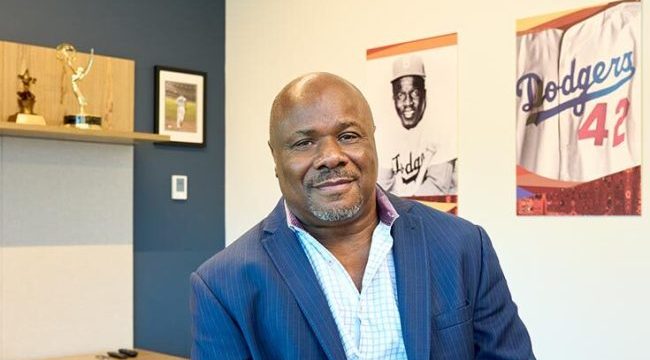
Retiring ESPN Exec. David Roberts Reflects on 50-Year Career, Detroit Roots, and the Importance of Opening Doors
After having spent the past 22 years of his career at ESPN, the worldwide leader in sports, the Southwestern High School and Wayne State University alum is retiring at the end of August 2026.
The rhythm of Detroit has always sounded a little like a game clock. It never quite stops and it always demands something from whomever is bold enough to step onto its floor.
For David Roberts, a kid growing up on the city’s southwest side, that rhythm stretched across five decades – a 50-year career that moved with the urgency of a fast break, but also with the patience of a long season. By the time he reached the executive ranks at ESPN after a quarter-century in the business, the pace hadn’t slowed. It just got sharper.
Roberts now serves as ESPN’s Executive Vice President and Executive Editor for Sports News and Entertainment. After 22 years at the organization, when he talks now about his pending August 2026 retirement, there’s no swelling music or grand curtain call in his voice. For him, retirement is just a measured acknowledgment of the time he spent in the journalism and media industry.
“Well, it just means that I’ve been around a while,” he said. “And you know, I’ve had a real interesting and refined career in the media world. I’m just looking forward to what’s next in this chapter of life.”
The path to that moment long before Roberts stepped into a newsroom or learned about press box etiquette.
It began in Detroit in 1967, when the city erupted and an 11-year-old boy started asking questions that adults around him couldn’t – or wouldn’t – answer.
“Going back, it went back to like the ’67 riots in Detroit,” Roberts said. “You know, I was always curious, even as an 11-year-old, about why certain media companies kind of refused to cover the real issues and stories associated with the Detroit riots.”
That curiosity turned into something more personal years later.
In summer 1978, as a student working at the National Bank of Detroit, Roberts became involved in a class-action lawsuit alleging race discrimination. The lawsuit stated that Black employees of the bank didn’t have similar access to promotions as their white counterparts – many of whom were equally or even less qualified for promotions.
The experience, while exposing him to what injustice looked and felt like, also reinforced how that 11-year-old Roberts saw the world. Answers became clearer about how and why those 1967 riots were portrayed in the media the way they were.
“I didn’t like how the story was covered, and frankly, how I was portrayed in the coverage of that story,” he said.
Those two moments – one civic and one deeply personal – laid the foundation of how he saw his career taking shape. Journalism, for Roberts, was the tool he could use to correct a broken narrative and bring about truth and fairness in a world that left him with too many unanswered questions and too many ignored perspectives.

Sports came later. But not in the way many people today enter into it, and not in the way people often assume.
There was no failed athletic career or last-minute pivot. Roberts knew early what he wanted.
“I played little league baseball and coached a bit of it later on, but that was as far as I went,” he said with a slight laugh. “But I always knew early on that I wanted to be in broadcasting. And so knowing early made it easier for me to carve out a path and a plan to achieve that goal.”
To him, sports and news were always complementary. They were just different lenses for the same camera.
“Sports is just another aspect of covering news,” he said. “If you have the same principles of coverage – fairness and balance – to me, sports were just another extension of broadcast journalism.”
That philosophy would follow him through every newsroom he entered, from his earliest days to the highest levels of ESPN, where he would spend 22 years shaping coverage, talent, and direction at what is often called the worldwide leader in sports. He’s ushered in a wave of new talent like Detroit product Vinnie Goodwill (brought over from Yahoo Sports), and basketball commentators Malika Andrews, Chiney Ogwumike and Andraya Carter.
He’s taken their anchor morning show First Take on the road for live shows at HBCU campuses since 2019. He brought back beloved personalities like Rich Eisen, overseen the network’s NBA and WNBA coverage, launched special editions of SportsCenter, and brought in record-high ratings for the network. And that’s really just the tip of the iceberg in terms of his accomplishments while at the network.
But before ESPN, there was Detroit.
Roberts graduated from Southwestern High School in 1974 and later from Wayne State University, building his foundation in a city that has long produced pioneering Black journalists. He points to those figures not as distant icons, but as tangible influences.
“Detroit has a history of being first with some of the most talented people in broadcast journalism,” he said, naming Diana Lewis, Beverly Payne, Doris Biscoe, and Carmen Harlan. “Those three women and Carmen Harlan really had a tremendous impact on my own career, just from watching them.”
He still speaks about them with a kind of reverence, recalling even brief professional overlap as meaningful.
“For the very short period of time that I worked with Diana Lewis, it was a privilege to do that,” he said. “I cannot overstate how tremendous of an impact they had, but particularly Diana Lewis, on my career.
That lineage – Detroit producing journalists who then shape national conversations – became something Roberts both inherited and extended. His first job in the business came at WGPR, a historic Black-owned television station in Detroit that served as a launching pad for many careers. It was the first Black-owned television station in the country, and it marked its 50-year anniversary in October 2025.
“I remind people of the history of WGPR, which was my first job in the business,” he said. “And hopefully people will never forget the impact that they had because they certainly produced a whole host of folks in the industry, including myself.”
By the time Roberts arrived at ESPN, he brought that history with him as a responsibility.
Over 22 years, he rose through the organization, taking on increasing leadership roles that culminated in Executive Vice President and Executive Editor of Sports News and Entertainment. His influence extended beyond programming decisions into hiring, mentorship, and institutional direction.
“I think that when you look at the people who are on the air at ESPN – persons of color – there are many of them that I was able to not only bring onboard but to help develop and provide guidance and feedback in a way where many of them are flourishing,” he said.
That work didn’t happen in isolation. It came during a time when conversations around diversity, equity, and inclusion were evolving, and, in Roberts’ view, increasingly under pressure.
“It is really important in today’s world… given the current attacks on the state of democracy and the moving away from diversity, equity and inclusion,” he said. “It only underscores the importance of making sure that Black communities across this country and other communities of color keep the heat on.”
His tone sharpens when he talks about it because he understands that issues of diversity, equity, and inclusion directly affects how stories are told and who gets to tell them. It goes back to his reasons for entering the industry.
“We can’t go back any further than what’s already happening,” he said. “It is not only the right thing to do, but it’s also good for business to be reflective of the communities that we cover and serve.”
That impact is visible to those who followed behind him.
Eric Woodyard, Flint native and ESPN’s Detroit Lions reporter, sees Roberts’ presence as a transformative shift in the industry.
“I think more than anything it gives us representation,” Woodyard said. “It gives us hope… that we’re not just pigeonholed into being just talent. You know, we can be in any position.”
For Woodyard, who came up through Michigan’s journalism ranks before reaching ESPN, seeing someone like Roberts in an executive role expanded what felt possible.
“I think that’s what makes him so unique,” Woodyard said. “That we’re not just on TV… we can be in production. We can be in all different types of roles. I think it’s important for young people coming up that they don’t believe that they just have to be in one position. There’s different roles, and we can be in those spaces as well.”
That visibility, he said, matters for the next generation in ways that go beyond inspiration. Woodyard also points to a broader shift in awareness that Roberts helped make possible.
“When I was coming up, I didn’t even know what the word journalist was for real,” he said. “I would just read the newspaper or Slam Magazine… I saw what Stuart Scott was doing on TV, but I didn’t necessarily know what that was called.”
Now, he says, that knowledge is more accessible.
“I think it’s just really awareness,” Woodyard said. “Seeing others like ourselves being in those positions to know that it’s possible.”
Roberts sees that awareness as part of his legacy, though he rarely frames it in personal terms. Instead, he points to outcomes: who is on screen, who is in the newsroom, who gets opportunities.
“Hopefully the legacy will be that I made a difference in what people see on the air and who people see on the air,” he said.
Even as he reflects on his career, Detroit remains a constant reference point. Roberts being a Detroiter only matters because of the perspective he gained from growing here, and it’s a perspective that he carries each day.
“When I was growing up, Coleman Young was the mayor of Detroit and he presented a very strong African American leadership perspective,” Roberts said. “He wasn’t necessarily well-liked by those who lived across Eight Mile… but he was always highly respected.”
That kind of unapologetic, rooted, and accountable leadership style left an impression.
“He was someone that inspired me,” Roberts said.
The city’s influence shows up in quieter ways, too: in the Little League fields where he coached, in the newsrooms where he first learned the craft, in the sense that journalism is a public trust.
Even his favorite sports moments reflect that sensibility. When asked to choose, he doesn’t default to championships or buzzer-beaters. Instead, he recalls something deeper.
“It was the 75th anniversary of Jackie Robinson breaking the color barrier,” he said. “The depth and reverence shown to his widow Rachel Robinson – just seeing how that historic figure continues to be a model of consistency and impact.”
It’s a choice that says as much about Roberts as any résumé line.
For him, sports – and news in general – has always been about history, legacy, and the stories that shape how we understand both.
As he steps away from ESPN, that perspective remains unchanged. Retirement, in his telling, is just a transition.
“Even though people call it retirement, the bottom line is my story is still being written,” he said.
In Detroit, the game clock never really stops. It will reset. There will be new players, and those new players will create new moments.
David Roberts spent 50 years moving to the ticks of the shot clock by asking questions, challenging narratives, opening doors, and breaking glass ceilings.
Now, as he looks toward the next chapter in his life, he’ll get a brand new clock to work with.
Sorry, the comment form is closed at this time.